

An email calendar can be full while the plan behind it is still unfinished. A date tells you when a message might go out; it does not explain why this person should receive it, what they need next or who will check the email before it sends.
For this marketing plan example, we will work through a customer email path using Prosperous Marketing's Inbox Impact Blueprint. The map connects calendar planning, an opt-in offer, list preparation, autoresponder setup and an honest review request. That gives us something more specific to examine than a list of possible marketing channels.
You can read the Inbox Impact Blueprint Library entry and follow its direct map link*. The framework brings together established email-funnel practices that Prosperous Marketing uses in its own business and with client brands. Here is how those steps can guide a practical plan.
Start with the customer moment
Before drafting a subject line, finish this sentence: this email is useful to this person now because…
Consider a home-organizing service that wants prospective clients to understand a consultation before they inquire. In this example, a consultation-preparation checklist gives people a useful first step.
Someone who has just requested the checklist needs the promised resource. A person considering a consultation may need help deciding whether to ask a question or book. A customer who has experienced the service may be ready to give feedback. Those are different situations, so the plan should not treat everyone as if they are at the same point.
If you do not have a list yet, I would start by building one around a question your prospects already ask. Brainstorm a useful way to answer it: a short how-to video, an animation, a checklist or a map. Offer that resource as a reason to subscribe, then use engagement over time to learn what people want next.
If you already have a list but little useful history, I would begin with a message covering the main interests your business serves. An e-commerce brand might link to apparel and home goods, then use category clicks to begin grouping subscribers by interest. Opens provide some context; where people click gives you a more specific starting point for the next message.
Build the plan with Inbox Impact Blueprint
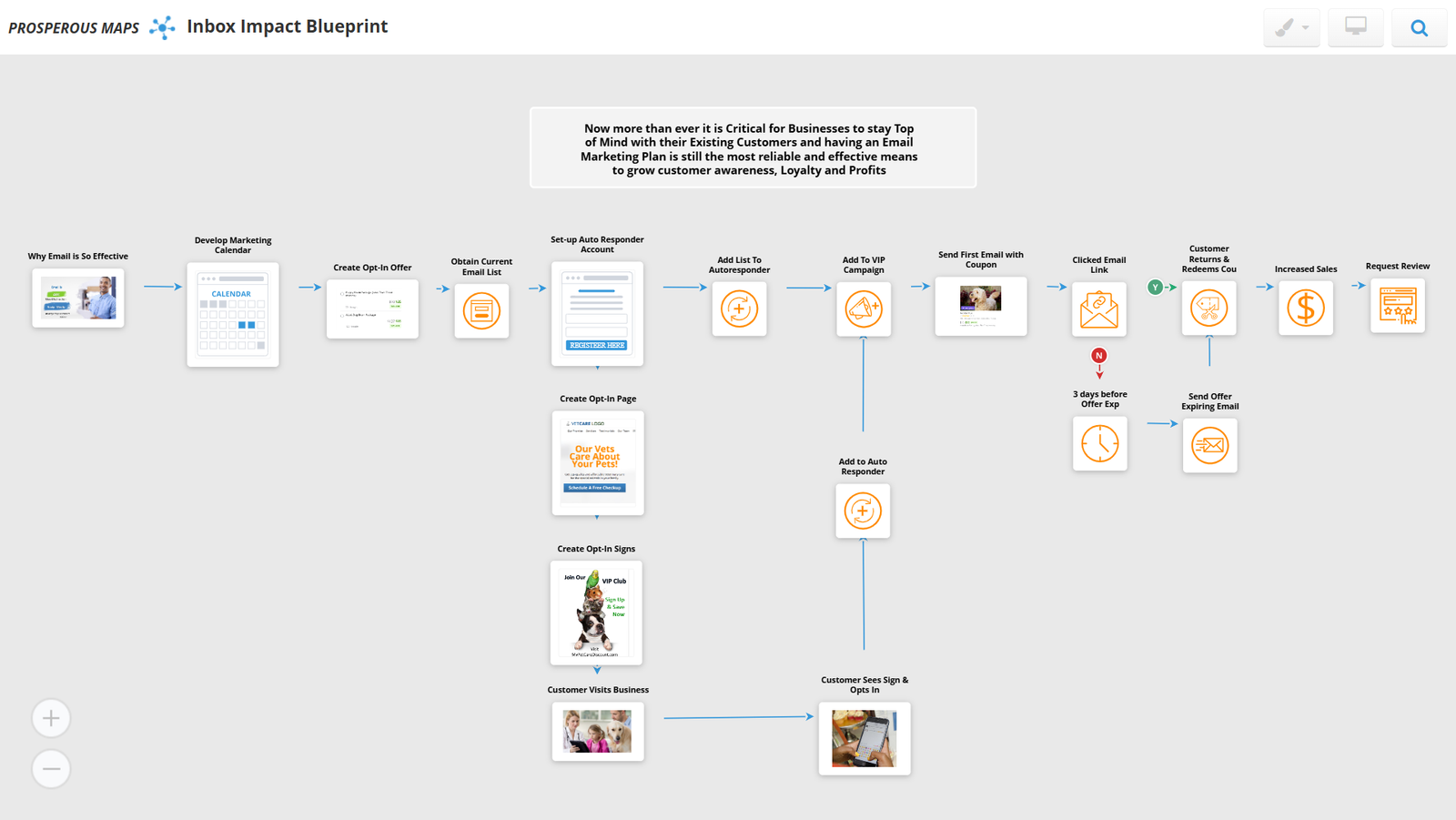
Inbox Impact Blueprint email marketing map.
Inbox Impact Blueprint organizes the work into five steps. Use them to connect the message to the relationship, while choosing the actual offer, timing and platform setup for your business.
Develop Marketing Calendar
Choose a reason to communicate, then decide when it belongs on the calendar. A season, service reminder or local event needs a connection to the people receiving the email and the business's purpose.
I put audience fit first. A local event, for example, needs a relevant local audience; its presence on a calendar is not enough. That is a useful filter for our example service: choose a customer question worth answering before filling another calendar slot.

A shop owner working with a promotion calendar.
Create Opt-In Offer
Make the subscription promise specific enough for someone to understand what they are requesting. In our example, the proposed checklist concerns preparing for a consultation; it should not imply a free consultation, discount or service that the business has not actually offered.
I consider what the initial offer means for both the customer relationship and the business economics. A useful resource starts that relationship; the follow-up should help people make progress toward the solution your product or service provides.
I start with the promise and the next useful step together: deliver the resource first, then help the subscriber work through the next gap it reveals. A consultation checklist might help someone prepare their questions; the next email could explain how to choose between handling the work themselves and getting help.
For me, the follow-up sequence should build that bridge toward the offer. By the time you make the pitch, subscribers should better understand the problem, their options and where your product fits. A resource-led welcome sequence builds the relationship through useful guidance; a discount-led campaign may follow a different path.
Obtain Current Email List
Check which records belong in the intended audience before planning a send. The map's list-preparation step covers record quality, permission context, engagement and grouping contacts by relevant source or customer type.
Do not assume that every old inquiry belongs in a new campaign. Check the permission and platform requirements applicable to the list, and keep opt-outs and suppression decisions intact. Engagement information may help you understand a relationship, but it is not a substitute for those checks.
For the hypothetical checklist path, record where the person signed up and what they requested. Keep prospects and customers distinguishable so a feedback request does not go to someone who has never received the service.
Set-up Autoresponder Account
Describe the message path before turning it on. Record what starts it, who should receive each message, what changes when someone books and what should stop further messages.
I proofread the emails and check variables, links and previews: does the resource link work, does a missing first name produce sensible copy, and can someone read the message on a phone? A completed diagram does not answer those questions.
Choose timing deliberately, and check that your platform supports the routing and conditions in your plan.
Request Review
I keep the feedback request attached to an actual customer experience. I choose the timing around the person's opportunity to experience the product or service; there is no single delay that fits every business.
For our example, the request belongs after the service has been experienced, not after someone merely downloads a checklist. Ask for honest feedback without prescribing a rating or treating a reply as a guaranteed endorsement.
An email marketing plan example
For the home-organizing example, the plan connects each customer moment to a useful email, a next action and a clear check.
| Customer moment | Proposed email purpose | Next action | Owner and check | Evidence to review |
|---|---|---|---|---|
| A person requests the consultation checklist | Deliver exactly the resource requested and explain what to expect | Open the checklist | Owner verifies the promise, audience and resource link | Delivery issues, relevant clicks and questions, where available |
| A subscriber considers whether a consultation fits | Explain an accurately defined part of the consultation and answer a relevant question | Ask a question or view the real consultation details | Owner checks service scope and the destination | Replies, inquiry themes and the available next-step information |
| A person books | Move them to the appropriate appointment communication | Review the actual preparation information | Responsible team member checks booking status and message routing | Whether booked clients receive the intended information |
| A customer has experienced the service | Thank them and invite honest feedback | Share their experience through the intended feedback route | Owner checks experience timing, wording and the real destination | Feedback received and questions needing a response |
Do not build every row automatically. First confirm that the business can deliver the resource, answer inquiries and distinguish the relevant customer stages. If those conditions are missing, the first activity may be fixing that connection rather than writing another email.
A printed marketing plan beside a pencil.
Turn the example into your own marketing plan template
For each planned email, record the business priority, intended recipient, customer moment, message promise, next action, owner, resources, timing, checks and review question. Keep a place for assumptions as well as decisions.
Start with one path you can explain and support. If an activity is waiting because the audience is unclear, the resource is unfinished or capacity is limited, record why it is deferred. You do not need to fill every channel with activity; you need a reason for the work you select.
When comparing marketing plan template examples or a marketing program sample, inspect the assumptions behind the activities. Borrow a useful planning structure without importing another business's audience, offer or calendar.
Give the plan an owner and a review question

Colleagues discussing a campaign roadmap.
An owner needs to know what they are responsible for completing, which details they must check and when the work will be reviewed. If other people contribute, make their contributions clear while keeping responsibility for the activity explicit.
At review, separate two questions: did the work happen as planned, and what evidence is available about its intended effect?
For this example, delivering the checklist is different from learning whether it helped someone assess the consultation. Choose a review question that reflects the purpose of that message, then examine the information you actually have. Replies and inquiries can raise useful questions; they do not automatically prove that an email caused a booking.
When clicks produce few useful inquiries, I check the offer first. Does the email accurately present it, and does the landing page carry through the same promise and next step? Review whether the people who clicked went on to take that step.
If a small number of clicks is converting, I would examine how well the audience fits the offer and whether I am reaching enough relevant people. If clicks lead nowhere, I would check the offer and landing-page alignment, then the email and offer alignment, before changing the message. Once those connections are sound, I would revisit audience fit and consider whether the offer itself needs to change.
Record the results you have, including zero and missing information. Use them to choose the next adjustment rather than changing the email, offer and audience all at once.
Put one email path into the plan
Open the Inbox Impact Blueprint Library entry for the overview, or use the direct map link* to examine the recorded map destination. Choose one customer moment and write down the recipient, reason for the message, next action and person responsible.
Before adding another email, make that first path clear enough that the person doing the work can explain its purpose and next step.
*Availability note — October 26, 2026: Prosperous Maps is temporarily unavailable. A wider PHP security issue has also led some websites to go offline while fixes are applied; see ABC News, October 22. This report does not establish the cause of the Maps interruption.